



The Shoulder Minute: Using Grooming to Calm Your Horse’s Nervous System
Some horses tell you they’re not comfortable before you’ve even started grooming: they fidget, step away, pin their ears, or brace the moment the brush makes contact.
This article shows you how to use one specific, consistent contact point to help your horse shift into a calmer, more ‘parasympathetic’ state before you even begin the main groom.
The technique is simple. The impact is not.
What’s happening when a horse ‘can’t stand being brushed’?
To appreciate the efficacy of the Shoulder Minute, one must first understand the horse's autonomic nervous system. The ANS is divided into two primary branches: the sympathetic nervous system (SNS), responsible for the 'fight or flight' response, and the parasympathetic nervous system (PNS), which facilitates 'rest and digest' functions.
Domestic horses often exist in a state of low-level chronic stress due to environmental factors, social isolation, or training demands. This results in a heightened sympathetic tone, manifested as increased heart rate, shallow respiration, and muscular tension. The Shoulder Minute acts as a physiological 'reset' button. By applying specific pressure to high-density nerve areas, we provide the sensory input required for the brain to down-regulate arousal.
If you watch horses in the field, you’ll see a pattern: mutual grooming often happens at the base of the neck and around the shoulder. It’s a social contact zone, not a random spot.
That matters, because the skin here contains a dense network of mechanoreceptors that translate touch into nervous system signals. Two you’ll often see referenced in touch research are:
- Merkel receptors: respond to steady pressure and texture
- Meissner’s corpuscles: respond to light touch and movement, especially when it’s consistent
When contact is predictable (same place, same pressure, steady rhythm), the brain is more likely to classify it as non-threatening. Over time, that shifts the body away from “ready to react” and towards “safe enough to soften”.
Rhythm is the secret: predictable strokes change the signal
The 'minute' in the Shoulder Minute is just as vital as the location. The horse’s nervous system requires a period of consistent, predictable input to register safety. Random or frantic brushing can actually increase arousal. In contrast, rhythmic contact: approximately one stroke every two seconds: provides a predictable external stimulus that the horse’s internal rhythms can synchronise with.
Heart Rate and Heart Rate Variability (HRV)
The physiological impact of this technique is measurable. Research into equine cardiology shows that targeted grooming at the withers and shoulder leads to a significant reduction in Heart Rate (HR). Perhaps more importantly, it improves Heart Rate Variability (HRV).
HRV is the measure of the variation in time between each heartbeat. A high HRV indicates a flexible, resilient nervous system capable of recovering from stress, whereas a low HRV suggests a system locked in a stress response. By implementing the Shoulder Minute, we are effectively training the horse’s heart to be more resilient, providing a foundation of certainty and calm before any physical work begins.
- Stand at the shoulder, facing towards the tail. Keep your body quiet and your feet planted.
- Find the seam: where the base of the neck blends into the shoulder (just in front of the wither/shoulder blade edge).
- Choose the right contact: your hand or a soft-but-firm brush that won’t scratch or snag.
- One minute. One rhythm. Stroke along the hair direction with steady pressure. Aim for one stroke every two seconds.
- If your horse steps away, keep the tempo rather than chasing them. The point is predictability, not restraint.
What relaxation looks like (the signs you’re waiting for)
You’ll usually see a shift within 30–60 seconds if the horse can settle:
- soft eyes (less “hard” stare; eyelids heavier)
- a longer, looser lower lip (sometimes the classic “long lip”)
- a deep exhale or sigh
- a lower head and neck
- quieter feet (less stepping, less tail swishing)
If you don’t see any of this, that’s useful information too: your horse may be sore, over-thin skinned, clipped and sensitive, or carrying stress that needs a broader plan.

Where this fits in a normal grooming routine
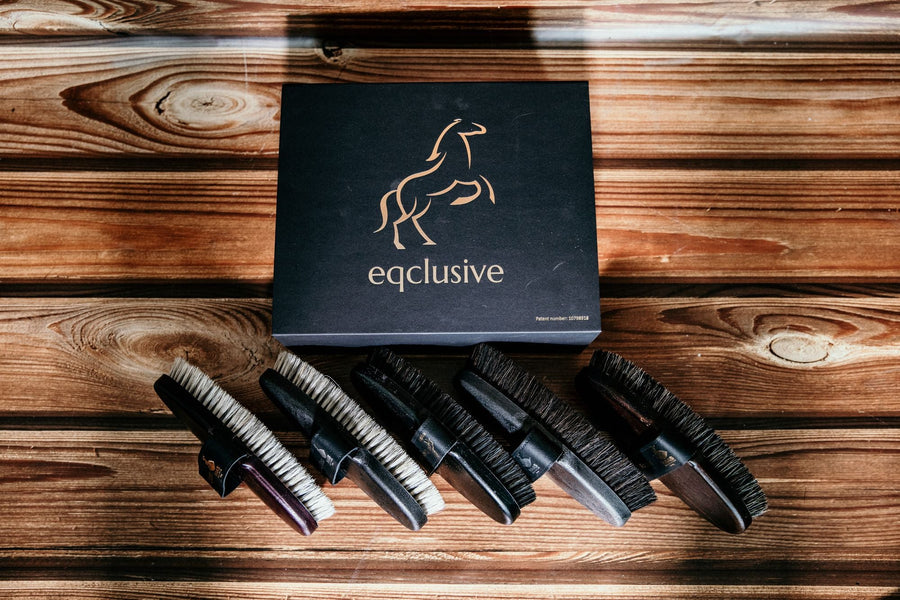
To integrate this into your daily care, start with the horse in a quiet environment. Before reaching for your standard grooming kit, use a brush with natural bristles or a specific finishing brush that offers a firm yet soft tactile experience.
Place your hand or the brush at the base of the neck, where it meets the shoulder blade. Use a steady, downward pressure, following the line of the hair. The motion should be slow and deliberate. If the horse moves away, do not increase pressure; maintain the rhythm until the nervous system begins to settle. This is not about cleaning; it is about communication.
By dedicating this initial minute to the shoulder, you are not just preparing the coat; you are preparing the mind. This level of intentionality is what separates basic horse care from educational leadership.

Eqclusive’s view is straightforward: grooming is feedback.
If a horse is tense, the coat care can’t be the only focus. The nervous system sets the baseline for everything that follows: how they stand, how they respond to touch, how well they recover, and how manageable they feel day to day.
That’s why the Eqclusive Method starts with the horse’s mind, then their coat.
And yes — your state matters too. If you’re rushed, heavy-handed, or inconsistent, the horse feels it. The Shoulder Minute is as much about getting you into a steady rhythm as it is about settling them.
Conclusion: start every groom with one minute of calm
If your horse fidgets when the brush lands, don’t treat it like a behaviour problem first. Treat it like information.
Use the neck–shoulder seam. Keep the rhythm steady. Wait for the softening: soft eyes, deeper breathing, long lip, lower head.
Then groom.
For more science-led, stable-tested guidance, join the Eqclusive community and explore our education hub: https://eqclusive.com/blogs/news


Leave a comment